
Home
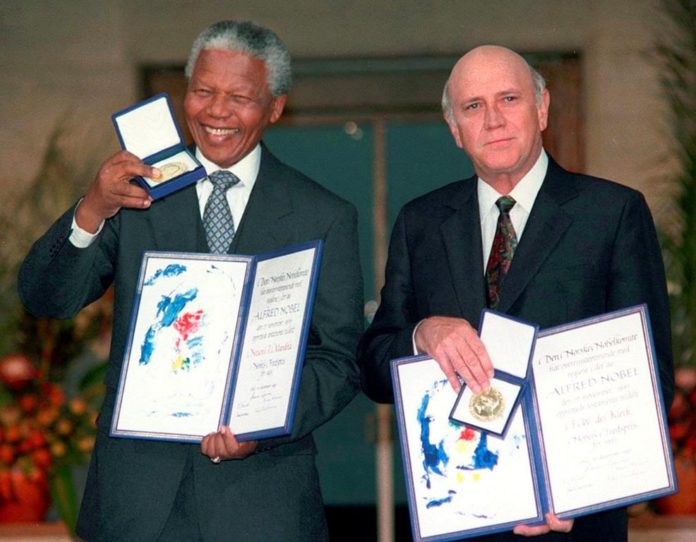
South Africa’s last apartheid president F. W. de Klerk dies
- Details
- Written by northsouth
- Category: Africa
- Hits: 1307
By ANDREW MELDRUM
JOHANNESBURG — F.W. de Klerk, who shared the Nobel Peace Prize with Nelson Mandela and as South Africa’s last apartheid president oversaw the end of the country’s white minority rule, has died at the age of 85.
De Klerk died after a battle against cancer at his home in the Fresnaye area of Cape Town, a spokesman for the F.W. de Klerk Foundation confirmed on Thursday.
De Klerk was a controversial figure in South Africa where many blamed him for violence against Black South Africans and anti-apartheid activists during his time in power, while some whites saw his efforts to end apartheid as a betrayal.
It was de Klerk who in a speech to South Africa’s parliament on Feb. 2, 1990, announced that Mandela would be released from prison after 27 years. The announcement electrified a country that for decades had been scorned and sanctioned by much of the world for its brutal system of racial discrimination known as apartheid.
With South Africa’s isolation deepening and its once-solid economy deteriorating, de Klerk, who had been elected president just five months earlier, also announced in the same speech the lifting of a ban on the African National Congress and other anti-apartheid political groups.
Amid gasps, several members of parliament members left the chamber as he spoke.
Nine days later, Mandela walked free.
Four years after that, Mandela was elected the country’s first Black president as Black South Africans voted for the first time.
By then, de Klerk and Mandela had been awarded the Nobel Peace Prize in 1993 for their often-tense cooperation in moving South Africa away from institutionalized racism and toward democracy.
Sudan braces for fresh protests against bloody coup
- Details
- Written by northsouth
- Category: Africa
- Hits: 1361

KHARTOUM - Sudanese anti-coup protesters plan to flood the streets Saturday to demonstrate against a military takeover that has derailed the country's transition to civilian rule and triggered deadly clashes.
The military on Monday detained Sudan's civilian leadership, dissolved the government and declared a state of emergency, leading to a chorus of international condemnation.
Street protests erupted against the coup, triggering a crackdown by the security forces that has left dead at least eight demonstrators and wounded around 170.
Despite the bloodshed, the protesters remain defiant, with organisers hoping to stage a "million-strong" march against the military's power grab on Saturday.
"We will not be ruled by the military. That is the message we will convey" at the protests, said Sudanese rights activist Tahani Abbas.
"The military forces are bloody and unjust and we are anticipating what is about to happen on the streets," Abbas said. "But we are no longer afraid."
Monday's takeover was led by General Abdel Fattah al-Burhan - Sudan's de facto leader since the 2019 ouster of longtime autocrat Omar al-Bashir after huge youth-led protests.
Several pro-democracy activists have been arrested.
On the eve of Saturday's rallies, a US official put the death toll at between 20 and 30, adding the protests would be a "real test" of the intentions of Sudan's military.
"We call on the security forces to refrain from any and all violence against protesters and to fully respect the citizens' right to demonstrate peacefully," the official in Washington said on condition of anonymity.
Phone lines were largely down by Saturday morning, as security forces deployed in large numbers on the streets and blocked bridges connecting the capital, Khartoum, with neighbouring cities.
Security forces set up random checkpoints on main roads, randomly frisking passers-by and searching cars.
Britain's special envoy for Sudan and South Sudan Robert Fairweather urged Sudan's security forces to "respect freedom and right of expression" for protesters.
"Peaceful protest is a fundamental democratic right. The security services and their leaders will bear responsibility for any violence towards any protesters," he said on Twitter.
'Grave setback'
Sudan has been led since August 2019 by a civilian-military ruling council, alongside Prime Minister Abdalla Hamdok's government, as part of the now stalled transition to full civilian rule.
Hamdok himself was briefly detained before he was released and placed under effective house arrest. Other civilian leaders and ministers are still being held.
Days of unrest have rocked Khartoum and other cities.
Protesters have barricaded roads with rocks, debris and burning tyres.
Shops have largely been shuttered, and government employees have refused to work as part of a campaign of civil disobedience.
"The Sudanese people are determined to... win back the gains of the December 2018 revolution" against Bashir, said Abdelgelil al-Basha from the capital's twin city of Omdurman.
Burhan, a senior general under Bashir's three decades of iron-fisted rule, has insisted the military takeover "was not a coup" but only meant to "rectify the course of the Sudanese transition".
The move triggered a wave of international condemnation and several punitive measures, with the World Bank and the United States freezing aid - a heavy blow to a country already mired in a dire economic crisis.
US President Joe Biden has called the coup a "grave setback", while the African Union has suspended Sudan's membership for the "unconstitutional" takeover.
On Friday, UN Secretary-General Antonio Guterres called on the military to show restraint as he reaffirmed his "strong condemnation" of the coup.
"People must be allowed to demonstrate peacefully," Guterres said.
Monday's power grab was the latest coup to hit impoverished Sudan, which has enjoyed only rare democratic interludes since independence in 1956 and spent decades riven by civil war.
France kills Islamic State leader
- Details
- Written by northsouth
- Category: Africa
- Hits: 1373

France says that the leader of ISIL (ISIS)-affiliated Islamic State in Greater Sahara (ISGS) group, known for its deadly attacks in the so-called tri-border region of Mali, Niger and Burkina Faso, has been killed by French forces.
“[Adnan Abu Walid al-Sahrawi], leader of the terrorist group Islamic State in the Greater Sahara was neutralised by French forces,” French President Emmanuel Macron said in a tweet on Thursday.
“This is another major success in our fight against terrorist groups in the Sahel,” Macron added, without providing details or location of the operation.
Rumours of the ISGS leader’s death had circulated for weeks in Mali, though authorities in the region had not confirmed it.
In another tweet, French Defence Minister Florence Parly said al-Sahrawi died following a raid by France’s Barkhane force – a 5,100-man operation active in the Sahel region for more than eight years.
“It is a decisive blow against this terrorist group,” she tweeted. “Our fight continues.”
The armed group’s leader was behind the killing of French aid workers in 2020 and was also wanted by the United States over a deadly 2017 attack on US troops in Niger.
ISGS, formed by al-Sahrawi in 2015, has been blamed for most of the attacks in recent years on civilians and soldiers in Mali, Niger and Burkina Faso.
The flashpoint area has frequently come under attack by ISGS and the al-Qaeda-affiliated Group for the Support of Islam and Muslims (GSIM).
The US had offered a $5 million reward for information on the whereabouts of al-Sahrawi, who was wanted over an October 4, 2017 attack in Niger that killed four US Special Forces and four Niger troops.
On August 9, 2020, in Niger, the ISGS head personally ordered the killing of six French aid workers and their Niger guides and drivers.
In late 2019, the group carried out a series of large-scale attacks against military bases in Mali and Niger.
A former member of Western Sahara’s Polisario Front independence movement, al-Sahrawi joined al-Qaeda in the Islamic Maghreb (AQIM) and had also co-led the Movement for Oneness and Jihad in West Africa or Mujao, a Malian armed group responsible for kidnapping Spanish aid workers in Algeria and a group of Algerian diplomats in Mali in 2012.
The French military has killed several high-ranking members of ISGS under its strategy of taking out fighters since the start of its military intervention in Mali in 2013.
In June this year, Macron announced a huge scaling back of France’s Barkhane force in the Sahel after more than eight years of military presence in the vast region to refocus on supporting local forces.
“The nation is thinking this evening of all its heroes who died for France in the Sahel in the Serval and Barkhane operations, of the bereaved families, of all its wounded,” Macron added in another tweet after al-Sahrawi was killed.
“Their sacrifice is not in vain. With our African, European and American partners, we will continue this fight.”
What caused South Africa’s week of rioting?
- Details
- Written by northsouth
- Category: Africa
- Hits: 1289

By ANDREW MELDRUM
JOHANNESBURG — South Africa has been rocked by the worst violence since the nation achieved democracy in 1994. Here is a closer look at the unrest.
WHAT TRIGGERED THE VIOLENCE?
The unrest began on July 8 when former President Jacob Zuma started serving a 15-month prison sentence for contempt of court. Supporters in his home province of KwaZulu-Natal set up roadblocks on major highways and burned about 20 trucks. The protests closed the N3 and N2 highways, which link the Indian Ocean ports of Durban and Richard’s Bay to the industrial hub of Johannesburg and to Cape Town.
The unrest spread within KwaZulu-Natal, where shopping malls and centers were ransacked by mobs that took food, electronics, clothes and liquor. Attacks on retail centers also spread inland to Gauteng province, to Johannesburg, the country’s largest city, and to Pretoria, the capital. In Durban and Pietermaritzburg, crowds attacked warehouses for major retailers and factories, which were set alight. Several burned until their roofs collapsed. The unrest lasted for a week until 25,000 army troops were deployed.
HOW BAD WERE THE RIOTS?
At least 215 people died in the unrest, and more than 2,500 were arrested on charges including theft and vandalism, according to government figures updated Monday.
The unrest was largely limited to the KwaZulu-Natal and Gauteng provinces, which together account for nearly 50% of South Africa’s GDP. The violence did not spread to South Africa’s other seven provinces.
Extensive damage was done to 161 malls and shopping centers, 11 warehouses, eight factories and 161 liquor stores and distributors, according to the government. An estimated 10 billion rand ($680 million) was lost in stolen goods, burned trucks and destroyed property, according to the Economist Intelligence Unit.
South Africa’s economy may sustain longer-term damage if domestic and international investors view the unrest as a sign that the country is not a safe destination for their capital. South Africa’s economy was already in recession, and the instability is expected to cause the economy to contract even further. The hardest hit will be South Africa’s poor, many of whom will not be able to buy food at competitive prices at the township shopping centers that have been closed or burned. People receiving monthly government grants, especially the elderly, will not be able to get them at centers that have been closed.
WHAT CAUSED THE DEATHS?
Police and government officials say many of the deaths were caused when people were crushed in stampedes during the chaotic ransacking of shops. At least 20 deaths occurred in the Phoenix area of KwaZulu-Natal, where residents were protecting their neighborhood from suspected intruders, according to Police Minister Bheki Cele. It is not known how many deaths were caused by police shooting at rioters.
Human rights organizations, including Amnesty International, are investigating the deaths.
WAS THE RIOTING SPONTANEOUS?
After Zuma entered prison, numerous posts on social media encouraged protests, including attacks on highways and on retail centers. Six people have been arrested on charges of inciting violence, the government announced Monday without disclosing their identities. One of those arrested has been released on bail. Five are still in custody.
“The unrest was orchestrated, instigated and planned ... It almost brought our country to its knees,” said acting Minister in the Presidency Khumbudzo Ntshavheni.
President Cyril Ramaphosa has also stated that the violence was planned. The police have said they have discovered large caches of ammunition.
The extent of the rioting exposed South Africa’s underlying economic problems, including high rates of unemployment and poverty. Unemployment is more than 32%, and it is above 64% for those under the age of 35, according to South African government statistics. More than half of the country’s 60 million people live in poverty, and more than 20% are food insecure. The country is one of the most unequal in the world, and that inequality has increased since apartheid ended in 1994, according to the World Bank.
WHY HAS ZUMA BECOME THE FOCUS FOR SO MANY LEGAL CASES?
Zuma, who has been a controversial figure for years, went to prison for contempt of court because he refused to testify before a judicial commission investigating allegations of corruption during his time as the country’s president from 2009 to 2018. The commission has heard damning testimony from former Cabinet ministers and top executives of state-owned corporations that Zuma allowed members of the wealthy Gupta family to influence his Cabinet appointments and the awarding of lucrative state contracts.
The 79-year-old Zuma also faces separate charges of corruption. He’s accused of receiving bribes from the French arms manufacturer Thales related to the country’s controversial 1999 arms procurement contracts. At that time, Zuma was a high-ranking official in the ruling African National Congress party and a provincial minister in KwaZulu-Natal. He is alleged to have received the bribes through his former financial advisor, Schabir Shaik, who was convicted on related charges in 2005, sentenced to prison and later released on medical parole.
Zuma was forced by his ANC party to step down as president in 2018 because of the growing allegations of corruption, but he still has a considerable following within the party, including other top ANC officials who are also facing corruption charges. Before he was imprisoned, Zuma made inflammatory speeches to his supporters in KwaZulu-Natal.
Human rights groups have welcomed his imprisonment. When he entered prison, the Nelson Mandela Foundation said it was pleased to see Zuma in custody and criticized him for “a pattern of disregard for the rule of law and for our constitutional democracy.”
The foundation said it was “profoundly disturbed” by Zuma’s willingness “to court public violence and lawlessness in support of political and personal agendas.”
WHAT WILL MAINTAIN STABILITY IN SOUTH AFRICA?
The deployment of 25,000 army troops to assist police has succeeded in establishing an uneasy calm over the country. The highways have reopened, and no violent incidents were reported Monday. Volunteer groups are helping to clean up trashed retail centers. It was not clear how long the military would be needed on the streets.
Main News
Error: No articles to display
latest news
- New blood test can spot breast cancer at earliest stages, scientists
- Sole bidders Saudi Arabia confirmed as hosts of 2034 men’s World Cup
- Nagasaki survivor accepts Nobel Peace Prize, calls for nuclear free world
- Countering Collapse in Haiti
- Crude oil price and production movements, OPEC
- IFAD, Nepal launch $120 million programme to help over 250,000 people
- DiEM25 challenges EU’s inhumane practices towards migrants
- Malibu wildfires forced thousands to evacuate their homes
- DRC: Senior army officials must be investigated for possible crimes
- Netanyahu describes corruption charges against him as ‘ocean of absurdity’ at trial
- Authorities disrupt migrant smuggling supply chain
- Israeli tanks '16 miles from Damascus' as overnight raids 'destroy Assad army's assets'
- In Haiti, women suffer the consequences of gang violence
- ICC arrest warrants for top Israeli officials are step toward justice
- Poland: Brutal Pushbacks at Belarus Border
- Sudan: War Crimes in South Cordovan, HRW
- Europeans politicians quick to promote hate against Syrian refugees
- Pentagon announces $988 million Ukraine Security Assistance package
- Trump says Russia, Iran in 'weakened state,' calls on Putin to make Ukraine deal
- $1.7 billion in airline funds blocked by governments
- 12 Ways to improve circulation for healthy blood flow, Doctors
- Action against ‘phone phishing’ gang in Belgium, Netherlands: 8 arrests
- $282 million program targeting agriculture and food systems
- What’s happening in Syria? The key developments as Assad flees to Russia
- UK nearly as divided as the US, report finds
Europe
DiEM25 challenges EU’s inhumane practices towards migrants
Authorities disrupt migrant smuggling supply chain
ICC arrest warrants for top Israeli officials are step toward justice
Poland: Brutal Pushbacks at Belarus Border
Europeans politicians quick to promote hate against Syrian refugees
Action against ‘phone phishing’ gang in Belgium, Netherlands: 8 arrests
UK nearly as divided as the US, report finds
Starmer rejects choice between EU and US allies
French government at risk of collapsing over 2025 budget
Belgium convicted of crimes against humanity for acts committed during colonisation
23rd International Economic Forum on Africa Monday 9 December
Putin Approves New Budget With Record Defence Spending
UK MPs back Assisted dying bill after emotionally-charged Commons debate
Ireland goes to polls with three parties neck and neck
Putin full of praise for ‘intelligent and experienced’ Trump
UK to continue selling arms to Israel despite Lebanon ceasefire, Starmer says
Crackdown on illegal streaming network with 22 million users worldwide
France says Israel's Netanyahu has immunity from ICC arrest warrant
Number of Europeans diagnosed with HIV rose in 2023 with new cases in most countries
Georgian prime minister suspends EU membership talks until end of 2028
Russian missile fired at Ukraine carried warheads without explosives
Russia advances in Ukraine at fastest monthly pace since start of war
Why are news outlets not covering crackdown on pro-Palestinian journalists in UK?
Starmer and Lammy are ‘monstrous war criminals’, Palestinian lawyer
Storm Bert brings severe flooding across UK
Asia
Nagasaki survivor accepts Nobel Peace Prize, calls for nuclear free world
IFAD, Nepal launch $120 million programme to help over 250,000 people
Embezzling property tycoon scrambles to raise $9bn to avoid death sentence
Pakistan: Everything we know about clashes between Imran Khan supporters and police
India: Mosque survey dispute erupts into deadly clashes
Taliban detained journalists over 250 times since takeover, UN
Philippines summons VP Duterte over threat to have Marcos killed
Four troops killed in Pakistan as protesters demand release of ex-PM Khan
Thousands of Imran Khan supporters defy arrest to head to capital
Pakistan sealing off capital ahead of planned rally by Imran Khan supporters
Fighting between armed sectarian groups in Pakistan kills at least 33 people
Rise in Afghan opium cultivation reflects economic hardship
Volcano erupts in Bali spewing five-mile ash cloud
New Delhi becomes world’s most polluted city as AQI levels reach 1,000
Pakistan’s toxic smog cover is now visible from space
Chinese driver 'angry about divorce settlement' ploughs into crowd leaving 35 dead
Taliban to attend UN climate conference for first time
Suicide bomber kills 24 in explosion at Pakistan train station
China unveils new heavy rocket that looks similar to SpaceX Starship
North Korea’s new ICBM missile records longest flight time yet
Japanese youth committed to fight poverty and hunger with IFAD
Japan's government in flux after election gives no party majority
Indan Muslims face discrimination after restaurants forced to display workers’ names
IFAD and Thailand sign agreement for new regional office in Bangkok
Nobel Peace Prize was awarded to the Japanese organization Nihon Hidankyo
Africa
DRC: Senior army officials must be investigated for possible crimes
Sudan: War Crimes in South Cordovan, HRW
Angola: US President Biden must demand immediate release of five critics
Wife of 'abducted' Ugandan opposition figure says he won't get justice
S.Africa opposition seeks to revive impeachment proceedings against Ramaphosa
Namibia may elect its first-ever female president in elections this week
Botswana turns to cannabis as diamonds are’s for ever
Influencers and social media beat mainstream media in Kenya
Mali’s ruling military appoints new prime minister
Regenerative Agriculture and Peace-building in South-central Somalia
Wits University unveils pan-African AI centre
'The UK will never forget Sudan,' says David Lammy
Sudan’s displaced have endured ‘unimaginable suffering, brutal atrocities’
Nearly half the world’s 1.1 billion poor live in conflict settings
Sudan war deaths are likely much higher than recorded
Africa’s mineral deposits can power the energy transition
The joint force of the AES ready to launch large-scale operations to secure Sahel
Mystery still surrounds death of revered UN chief Hammarskjöld, 63 years after plane crash
IFAD and Sierra Leone partner to boost farm productivity
Mozambique: End violent post-election crackdown ahead of 7 November Maputo march
Africa: Richer countries must commit to pay at COP29
Sudan’s ‘living nightmare’ continues as 11 million flee war
‘Alarming’ situation in Great Lakes Region of DR Congo
Climate change worsened rains in flood-hit African regions, scientists
African progress backslides as coups and war persist
Americas
Countering Collapse in Haiti
Malibu wildfires forced thousands to evacuate their homes
In Haiti, women suffer the consequences of gang violence
Pentagon announces $988 million Ukraine Security Assistance package
Trump says Russia, Iran in 'weakened state,' calls on Putin to make Ukraine deal
Musk dealt legal defeat in battle over $56 billion Tesla pay deal
Autonomous Systems Impact on Modern Warfare
US, Israel, China, and the Shifting Arms Trade in the Middle East
Support the Court, HRW
Private prisons in US stand to cash in from Trump’s mass deportation plan
G7 Foreign Ministers’ Meeting Statement
War Crimes Weapons: Made in the USA
Trump Cabinet and executive branch of different ideas and eclectic personalities
Trump Says He Will Impose 25% Tariff on Canada and Mexico on Day one
Prosecutors drop election interference and documents cases against Trump
Number of children recruited by gangs in Haiti soars by 70%, UNICEF
Archaeologists discover 4,000-year-old canals used to fish by predecessors of ancient Maya
Democrats in Congress urge Biden to sanction Israelis over West Bank violence
Susan Sarandon opens up on exile from Hollywood after PRO-Palestine remarks
What could Trump’s election win mean for Ukraine and the Middle East
Trump deploys garbage truck to trash Biden gaffe at Wisconsin rally
US calls on Israel to tackle ‘catastrophic humanitarian crisis’ in Gaza
Vinicius's Ballon d’Or snub sparks fury in Brazil amid claims of racism
CNN guest thrown off air after telling Mehdi Hasan:‘I hope your beeper doesn’t go off’
Pentagon warns North Korea as 10,000 troops set to join Russia’s war
Australia & Pacific
Australia passes world-first ban on social media for under 16s into law
New Zealanders save over 30 stranded whales by lifting them on sheets
Commonwealth leaders say 'time has come' for discussion on slavery reparations
Generational export reforms to boost AUKUS trade and collaboration
Australia lawmaker calls opposition leader racist over opposition to Gaza refugees
Agreement strengthens AUKUS submarine partnership
Passionate welcome for WikiLeaks founder Assange as he lands in Australia
Violent protests return to New Caledonia as pro-independence leader extradited
EU and Australia accelerate their digital cooperation
Over 2,000 people thought to have been buried alive in Papua New Guinea landslide
Over 670 people died in a massive Papua New Guinea landslide, UN
Macron says extra security to stay in riot-hit New Caledonia as long as needed
New Caledonia riots: Tourists evacuated, President Macron to visit
Hundreds more French police start deploying to secure New Caledonia
France declares state of emergency in New Caledonia as protests rage
Australia’s 2024 National Defence Strategy
Sydney rocked by second mass stabbing as knifeman attacks bishop
Three dead, 1,000 homes destroyed in Papua New Guinea quake
Australia and UK sign defense and security treaty
Australia tightens student visa rules as migration hits record high
Global food crisis and the effects of climate change need urgent action, IFAD
Indonesia, Australia to sign defence pact within months
Australia to ban doxxing after pro-Palestinians publish information about hundreds of Jews
Australia launches inquiry into why Cabinet documents relating to Iraq war remain secret
Australia says AI will help track Chinese submarines under new Aukus plan
MENA
Netanyahu describes corruption charges against him as ‘ocean of absurdity’ at trial
Israeli tanks '16 miles from Damascus' as overnight raids 'destroy Assad army's assets'
What’s happening in Syria? The key developments as Assad flees to Russia
Who is Abu Mohammed al-Golani, leader of insurgency that toppled Syria’s Assad?
Syrian leader Bashar Assad in Moscow, State news agency
IFAD and Kuwait agree to strengthen efforts to support small-scale farmers
Israel responds to Hezbollah rocket attack with airstrikes on south Lebanon
Egypt: Education Restricted for Refugee
At least 25 killed in counter air strikes by Syrian army on rebels in north-west
UNRWA suspends aid delivery to Gaza after lorries looted at gunpoint
Who are the Syrian rebels HTS and why are they advancing?
Syrian rebels capture centre of Aleppo in major blow to Assad regime
World Central Kitchen stops work in Gaza after three aid workers killed by Israeli strike
Lebanon must elect president during 60-day truce with Israel as part of ceasefire
Abbas clarifies PA presidency succession plan but experts unconvinced
At least 10 killed in Israeli air strike on Beit Lahia
UN calls for accountability and investigations in Israel-Hezbollah conflict
Saudi Arabia approves 2025 budget with estimated $315bn
Lebanon faces $25bn reconstruction bill after Israel-Hezbollah ceasefire
Israeli military to remain in Gaza for years, food minister says
Israeli government orders officials to boycott left-leaning paper Haaretz
In East Jerusalem, record number of homes destroyed to drive out Palestinian residents
Biden: Israel and Hezbollah Ceasefire deal can be blueprint to end Gaza war
Heavy rain and high waves wash away tents of Gaza's displaced
Saudi NEOM gigaproject a 'generational investment,' minister
Banners



Videos
-
Future of car-plane, see it to believe it
https://www.youtube.com/watch?v=D4uSWtazRCM
-
Mehdi Hasan: Islam is a peaceful religion
https://www.youtube.com/watch?v=Jy9tNyp03M0 -
Python swallows antelope whole in under an hour
https://www.youtube.com/watch?v=x0rk5zh7RaE
-
Sangoku dance
http://www.youtube.com/watch?v=Df1SkeiPEAo -
flying 3 kites wonder!
https://www.youtube.com/watch?v=nr9KrqN_lIg
-
Korea has talent
http://www.youtube.com/watch?v=tZ46Ot4_lLo&feature=related -
Paul Potts sings Nessun Dorma
http://www.youtube.com/watch?v=1k08yxu57NA
-
Susan Boyle - Britain's Got Talent
http://www.youtube.com/watch?v=RxPZh4AnWyk -
Twist and Pulse - Britain's Got Talent
http://www.youtube.com/watch?v=1RDiBxbT_CA -
Shaheen Jafargholi (HQ) Britain's Got Talent
http://www.youtube.com/watch?v=VYDM3MIzEHo
High-Quality clip of 12-year-old singer Shaheen Jafargholi auditioning on Britain's Got Talent 2009. First he sings Valerie by The Zutons, as performed by Amy Winehouse, but, after Simon interrupts him and asks for a different song, he just blew everyone away. -
David Calvo juggles and solves Rubik's Cubes
http://www.youtube.com/watch?v=lhkzgjOKeLs
-
Outdoor 'bubble pod' hotel unveiled
http://www.youtube.com/watch?v=9IPBKlWf-cA